
Question of the Month
November 2011
Which produces the better image,
a 1.4X tele-converter or a cropped image
from a prime lens?
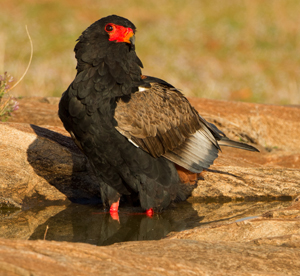
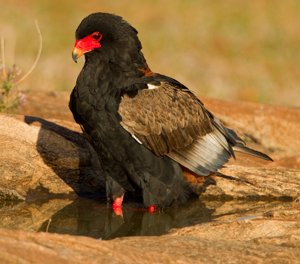
The left image was shot with a 500mm and cropped to match the cropped 700mm shot. Both were cropped, but the 500mm shot was cropped far more. See below for an enlargement of the heads of each.
I am frequently asked was gives the better result for a large image size, a 1.4X tele-converter attached to a prime lens like a 500mm, or cropping the image made with the 500mm lens alone. Years ago, when digital photography was still relatively new, I was worried about dust on my sensor and to prevent or minimize dust I kept a 1.4X converter almost permanently attached to my camera body. Whether I was shooting with a 70-200mm zoom, a 500mm f4 or a 600mm f4, I had the converter and the resulting larger image size.
One day, while on a Kenya Photo Safari, I had a leopard that was too close to be framed well with the 600mm and converter. Reluctantly, I removed the converter, recomposed for the now much improved image, and fired with the 600mm focal length alone. That evening, when reviewing my images on my laptop, I couldn't believe the differences in quality. The prime lens alone produced results so sharp it looked, in comparison, as if I had used a cheap knock-off lens for the firwst series of shots. I reconsidered my use of a tele-converter and from that point onward I've almost always shot with the prime lens alone, using the 1.4X only when I absolutely had to.
This anecdote certainly doesn't truly prove anything as the test was not really very controlled. On our last photo safari I repeated this same poorly controlled test with a Batelur Eagle that was bathing in a distant pool. I started with my 500mm alone, and after a series of shots I added a converter. I tried as best I could to be as rock-steady for both shots, and I used the same exposure settings and ISO.
When I looked at the images later the 700mm shots, via the converter, were not as sharp but I can't rule out some camera movement from being in the vehicle. Nonetheless, there was a difference. However...
After doing my RAW manipulations I cropped both images to approximately the same image size for the eagle and I converted both into the jpgs you see here. As jpgs, both are certainly acceptable, so to make a real determination from a website image, or from a jpg, may be a moot point. In December, I hope to do this test under controlled conditions where I'll have a sturdily mounted tripod, use flash, and really be able to see a difference in a line chart. But until then, I prefer using my 500mm lens without a converter unless it is absolutely necessary. I have a strong suspicion that the cropped image is sharper than the one made with a converter.

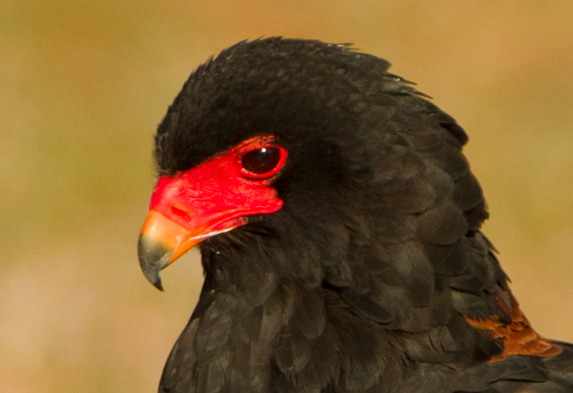
As you can see with these two photos, however, there really appears to be virtually no difference between them.
I suspect that as a print both would be acceptable as well. So the question still is, which is better?
On a related point, a smaller image size, at any given distance, generally provides greater depth of field than a larger image size, if shot at the same f stop. This is an important tip for macro photography, as you'll be better off cropping a 1:3 image to something approaching life-size than to actually shoot a 1:1 image as the depth of field will be greater. The resolution may not be as good, depending upon the pixel count of your camera, but I'm betting in most cases it would be better. Further, on this same note, photographers have a tendency to stop down to f16 or 22 or 32 to get the maximum depth of field when at 1:1, but small apertures can result in lens defraction as light is now passing through a tiny opening and is bent severely by doing so. There is less defraction at wider apertures, so you might make the best trade-off by using f11 or f16 (vs f22 or 32) and backing off to 1:3 and crop, so that the sharpness is maximized. Alternatively, the Helicon Focus filter (software) can be used with static subjects at wide apertures for maximum depth of field and sharpness.
Questions of the Month
What gear is essential for being in the field?
How Easy is NIK's HDR Program to use?
What is the most endangered big cat to photograph?
Why did we drop our NANPA membership?
What is the best $69 you can spend in photography?
More Questions about Pumas in Pennsylvania
Are the Latest Fast CF Cards worth the Expense?
How does the 7D hold up in a recent shoot?
Which is the better camera, the Mark IV or the 7D?
Are there Mountain Lions (Pumas, Cougars) in Pennsylvania and the Mid-Atlantic States?
Why is bat photography so difficult?
What do I think of the Canon 1D Mark IV?
Why do I advocate manual exposure so avidly?
Where can I find Depth of Field reference charts?
What is the Keboko backpack? Is it the New Best Pack?
Is there a correct position for the upright on a Wimberley actionhead?
How, Who, and Why? The story behind our new web site.
Archived Questions of the Month
Most of my original Questions of the Month for the last several
years are available through this link. The 'look' is from my
original web site, although if I ever have enough time I might
redo these pages to match the new web site But that's not
a high priority.
Question of the Month
November 2011
Which produces the better image,
a 1.4X tele-converter or a cropped image
from a prime lens?
The left image was shot with a 500mm and cropped to match the cropped 700mm shot. Both were cropped, but the 500mm shot was cropped far more. See below for an enlargement of the heads of each.
I am frequently asked was gives the better result for a large image size, a 1.4X tele-converter attached to a prime lens like a 500mm, or cropping the image made with the 500mm lens alone. Years ago, when digital photography was still relatively new, I was worried about dust on my sensor and to prevent or minimize dust I kept a 1.4X converter almost permanently attached to my camera body. Whether I was shooting with a 70-200mm zoom, a 500mm f4 or a 600mm f4, I had the converter and the resulting larger image size.
One day, while on a Kenya Photo Safari, I had a leopard that was too close to be framed well with the 600mm and converter. Reluctantly, I removed the converter, recomposed for the now much improved image, and fired with the 600mm focal length alone. That evening, when reviewing my images on my laptop, I couldn't believe the differences in quality. The prime lens alone produced results so sharp it looked, in comparison, as if I had used a cheap knock-off lens for the firwst series of shots. I reconsidered my use of a tele-converter and from that point onward I've almost always shot with the prime lens alone, using the 1.4X only when I absolutely had to.
This anecdote certainly doesn't truly prove anything as the test was not really very controlled. On our last photo safari I repeated this same poorly controlled test with a Batelur Eagle that was bathing in a distant pool. I started with my 500mm alone, and after a series of shots I added a converter. I tried as best I could to be as rock-steady for both shots, and I used the same exposure settings and ISO.
When I looked at the images later the 700mm shots, via the converter, were not as sharp but I can't rule out some camera movement from being in the vehicle. Nonetheless, there was a difference. However...
After doing my RAW manipulations I cropped both images to approximately the same image size for the eagle and I converted both into the jpgs you see here. As jpgs, both are certainly acceptable, so to make a real determination from a website image, or from a jpg, may be a moot point. In December, I hope to do this test under controlled conditions where I'll have a sturdily mounted tripod, use flash, and really be able to see a difference in a line chart. But until then, I prefer using my 500mm lens without a converter unless it is absolutely necessary. I have a strong suspicion that the cropped image is sharper than the one made with a converter.
As you can see with these two photos, however, there really appears to be virtually no difference between them.
I suspect that as a print both would be acceptable as well. So the question still is, which is better?
On a related point, a smaller image size, at any given distance, generally provides greater depth of field than a larger image size, if shot at the same f stop. This is an important tip for macro photography, as you'll be better off cropping a 1:3 image to something approaching life-size than to actually shoot a 1:1 image as the depth of field will be greater. The resolution may not be as good, depending upon the pixel count of your camera, but I'm betting in most cases it would be better. Further, on this same note, photographers have a tendency to stop down to f16 or 22 or 32 to get the maximum depth of field when at 1:1, but small apertures can result in lens defraction as light is now passing through a tiny opening and is bent severely by doing so. There is less defraction at wider apertures, so you might make the best trade-off by using f11 or f16 (vs f22 or 32) and backing off to 1:3 and crop, so that the sharpness is maximized. Alternatively, the Helicon Focus filter (software) can be used with static subjects at wide apertures for maximum depth of field and sharpness.
Questions of the Month
What gear is essential for being in the field?
How Easy is NIK's HDR Program to use?
What is the most endangered big cat to photograph?
Why did we drop our NANPA membership?
What is the best $69 you can spend in photography?
More Questions about Pumas in Pennsylvania
Are the Latest Fast CF Cards worth the Expense?
How does the 7D hold up in a recent shoot?
Which is the better camera, the Mark IV or the 7D?
Are there Mountain Lions (Pumas, Cougars) in Pennsylvania and the Mid-Atlantic States?
Why is bat photography so difficult?
What do I think of the Canon 1D Mark IV?
Why do I advocate manual exposure so avidly?
Where can I find Depth of Field reference charts?
What is the Keboko backpack? Is it the New Best Pack?
Is there a correct position for the upright on a Wimberley actionhead?
How, Who, and Why? The story behind our new web site.
Archived Questions of the Month
Most of my original Questions of the Month for the last several
years are available through this link. The 'look' is from my
original web site, although if I ever have enough time I might
redo these pages to match the new web site But that's not
a high priority.
Question of the Month
November 2011
Which produces the better image,
a 1.4X tele-converter or a cropped image
from a prime lens?
The left image was shot with a 500mm and cropped to match the cropped 700mm shot. Both were cropped, but the 500mm shot was cropped far more. See below for an enlargement of the heads of each.
I am frequently asked was gives the better result for a large image size, a 1.4X tele-converter attached to a prime lens like a 500mm, or cropping the image made with the 500mm lens alone. Years ago, when digital photography was still relatively new, I was worried about dust on my sensor and to prevent or minimize dust I kept a 1.4X converter almost permanently attached to my camera body. Whether I was shooting with a 70-200mm zoom, a 500mm f4 or a 600mm f4, I had the converter and the resulting larger image size.
One day, while on a Kenya Photo Safari, I had a leopard that was too close to be framed well with the 600mm and converter. Reluctantly, I removed the converter, recomposed for the now much improved image, and fired with the 600mm focal length alone. That evening, when reviewing my images on my laptop, I couldn't believe the differences in quality. The prime lens alone produced results so sharp it looked, in comparison, as if I had used a cheap knock-off lens for the firwst series of shots. I reconsidered my use of a tele-converter and from that point onward I've almost always shot with the prime lens alone, using the 1.4X only when I absolutely had to.
This anecdote certainly doesn't truly prove anything as the test was not really very controlled. On our last photo safari I repeated this same poorly controlled test with a Batelur Eagle that was bathing in a distant pool. I started with my 500mm alone, and after a series of shots I added a converter. I tried as best I could to be as rock-steady for both shots, and I used the same exposure settings and ISO.
When I looked at the images later the 700mm shots, via the converter, were not as sharp but I can't rule out some camera movement from being in the vehicle. Nonetheless, there was a difference. However...
After doing my RAW manipulations I cropped both images to approximately the same image size for the eagle and I converted both into the jpgs you see here. As jpgs, both are certainly acceptable, so to make a real determination from a website image, or from a jpg, may be a moot point. In December, I hope to do this test under controlled conditions where I'll have a sturdily mounted tripod, use flash, and really be able to see a difference in a line chart. But until then, I prefer using my 500mm lens without a converter unless it is absolutely necessary. I have a strong suspicion that the cropped image is sharper than the one made with a converter.
As you can see with these two photos, however, there really appears to be virtually no difference between them.
I suspect that as a print both would be acceptable as well. So the question still is, which is better?
On a related point, a smaller image size, at any given distance, generally provides greater depth of field than a larger image size, if shot at the same f stop. This is an important tip for macro photography, as you'll be better off cropping a 1:3 image to something approaching life-size than to actually shoot a 1:1 image as the depth of field will be greater. The resolution may not be as good, depending upon the pixel count of your camera, but I'm betting in most cases it would be better. Further, on this same note, photographers have a tendency to stop down to f16 or 22 or 32 to get the maximum depth of field when at 1:1, but small apertures can result in lens defraction as light is now passing through a tiny opening and is bent severely by doing so. There is less defraction at wider apertures, so you might make the best trade-off by using f11 or f16 (vs f22 or 32) and backing off to 1:3 and crop, so that the sharpness is maximized. Alternatively, the Helicon Focus filter (software) can be used with static subjects at wide apertures for maximum depth of field and sharpness.
Questions of the Month
What gear is essential for being in the field?
How Easy is NIK's HDR Program to use?
What is the most endangered big cat to photograph?
Why did we drop our NANPA membership?
What is the best $69 you can spend in photography?
More Questions about Pumas in Pennsylvania
Are the Latest Fast CF Cards worth the Expense?
How does the 7D hold up in a recent shoot?
Which is the better camera, the Mark IV or the 7D?
Are there Mountain Lions (Pumas, Cougars) in Pennsylvania and the Mid-Atlantic States?
Why is bat photography so difficult?
What do I think of the Canon 1D Mark IV?
Why do I advocate manual exposure so avidly?
Where can I find Depth of Field reference charts?
What is the Keboko backpack? Is it the New Best Pack?
Is there a correct position for the upright on a Wimberley actionhead?
How, Who, and Why? The story behind our new web site.
Archived Questions of the Month
Most of my original Questions of the Month for the last several
years are available through this link. The 'look' is from my
original web site, although if I ever have enough time I might
redo these pages to match the new web site But that's not
a high priority.
Question of the Month
November 2011
Which produces the better image,
a 1.4X tele-converter or a cropped image
from a prime lens?
The left image was shot with a 500mm and cropped to match the cropped 700mm shot. Both were cropped, but the 500mm shot was cropped far more. See below for an enlargement of the heads of each.
I am frequently asked was gives the better result for a large image size, a 1.4X tele-converter attached to a prime lens like a 500mm, or cropping the image made with the 500mm lens alone. Years ago, when digital photography was still relatively new, I was worried about dust on my sensor and to prevent or minimize dust I kept a 1.4X converter almost permanently attached to my camera body. Whether I was shooting with a 70-200mm zoom, a 500mm f4 or a 600mm f4, I had the converter and the resulting larger image size.
One day, while on a Kenya Photo Safari, I had a leopard that was too close to be framed well with the 600mm and converter. Reluctantly, I removed the converter, recomposed for the now much improved image, and fired with the 600mm focal length alone. That evening, when reviewing my images on my laptop, I couldn't believe the differences in quality. The prime lens alone produced results so sharp it looked, in comparison, as if I had used a cheap knock-off lens for the firwst series of shots. I reconsidered my use of a tele-converter and from that point onward I've almost always shot with the prime lens alone, using the 1.4X only when I absolutely had to.
This anecdote certainly doesn't truly prove anything as the test was not really very controlled. On our last photo safari I repeated this same poorly controlled test with a Batelur Eagle that was bathing in a distant pool. I started with my 500mm alone, and after a series of shots I added a converter. I tried as best I could to be as rock-steady for both shots, and I used the same exposure settings and ISO.
When I looked at the images later the 700mm shots, via the converter, were not as sharp but I can't rule out some camera movement from being in the vehicle. Nonetheless, there was a difference. However...
After doing my RAW manipulations I cropped both images to approximately the same image size for the eagle and I converted both into the jpgs you see here. As jpgs, both are certainly acceptable, so to make a real determination from a website image, or from a jpg, may be a moot point. In December, I hope to do this test under controlled conditions where I'll have a sturdily mounted tripod, use flash, and really be able to see a difference in a line chart. But until then, I prefer using my 500mm lens without a converter unless it is absolutely necessary. I have a strong suspicion that the cropped image is sharper than the one made with a converter.
As you can see with these two photos, however, there really appears to be virtually no difference between them.
I suspect that as a print both would be acceptable as well. So the question still is, which is better?
On a related point, a smaller image size, at any given distance, generally provides greater depth of field than a larger image size, if shot at the same f stop. This is an important tip for macro photography, as you'll be better off cropping a 1:3 image to something approaching life-size than to actually shoot a 1:1 image as the depth of field will be greater. The resolution may not be as good, depending upon the pixel count of your camera, but I'm betting in most cases it would be better. Further, on this same note, photographers have a tendency to stop down to f16 or 22 or 32 to get the maximum depth of field when at 1:1, but small apertures can result in lens defraction as light is now passing through a tiny opening and is bent severely by doing so. There is less defraction at wider apertures, so you might make the best trade-off by using f11 or f16 (vs f22 or 32) and backing off to 1:3 and crop, so that the sharpness is maximized. Alternatively, the Helicon Focus filter (software) can be used with static subjects at wide apertures for maximum depth of field and sharpness.
Questions of the Month
What gear is essential for being in the field?
How Easy is NIK's HDR Program to use?
What is the most endangered big cat to photograph?
Why did we drop our NANPA membership?
What is the best $69 you can spend in photography?
More Questions about Pumas in Pennsylvania
Are the Latest Fast CF Cards worth the Expense?
How does the 7D hold up in a recent shoot?
Which is the better camera, the Mark IV or the 7D?
Are there Mountain Lions (Pumas, Cougars) in Pennsylvania and the Mid-Atlantic States?
Why is bat photography so difficult?
What do I think of the Canon 1D Mark IV?
Why do I advocate manual exposure so avidly?
Where can I find Depth of Field reference charts?
What is the Keboko backpack? Is it the New Best Pack?
Is there a correct position for the upright on a Wimberley actionhead?
How, Who, and Why? The story behind our new web site.
Archived Questions of the Month
Most of my original Questions of the Month for the last several
years are available through this link. The 'look' is from my
original web site, although if I ever have enough time I might
redo these pages to match the new web site But that's not
a high priority.
Question of the Month
November 2011
Which produces the better image,
a 1.4X tele-converter or a cropped image
from a prime lens?
The left image was shot with a 500mm and cropped to match the cropped 700mm shot. Both were cropped, but the 500mm shot was cropped far more. See below for an enlargement of the heads of each.
I am frequently asked was gives the better result for a large image size, a 1.4X tele-converter attached to a prime lens like a 500mm, or cropping the image made with the 500mm lens alone. Years ago, when digital photography was still relatively new, I was worried about dust on my sensor and to prevent or minimize dust I kept a 1.4X converter almost permanently attached to my camera body. Whether I was shooting with a 70-200mm zoom, a 500mm f4 or a 600mm f4, I had the converter and the resulting larger image size.
One day, while on a Kenya Photo Safari, I had a leopard that was too close to be framed well with the 600mm and converter. Reluctantly, I removed the converter, recomposed for the now much improved image, and fired with the 600mm focal length alone. That evening, when reviewing my images on my laptop, I couldn't believe the differences in quality. The prime lens alone produced results so sharp it looked, in comparison, as if I had used a cheap knock-off lens for the firwst series of shots. I reconsidered my use of a tele-converter and from that point onward I've almost always shot with the prime lens alone, using the 1.4X only when I absolutely had to.
This anecdote certainly doesn't truly prove anything as the test was not really very controlled. On our last photo safari I repeated this same poorly controlled test with a Batelur Eagle that was bathing in a distant pool. I started with my 500mm alone, and after a series of shots I added a converter. I tried as best I could to be as rock-steady for both shots, and I used the same exposure settings and ISO.
When I looked at the images later the 700mm shots, via the converter, were not as sharp but I can't rule out some camera movement from being in the vehicle. Nonetheless, there was a difference. However...
After doing my RAW manipulations I cropped both images to approximately the same image size for the eagle and I converted both into the jpgs you see here. As jpgs, both are certainly acceptable, so to make a real determination from a website image, or from a jpg, may be a moot point. In December, I hope to do this test under controlled conditions where I'll have a sturdily mounted tripod, use flash, and really be able to see a difference in a line chart. But until then, I prefer using my 500mm lens without a converter unless it is absolutely necessary. I have a strong suspicion that the cropped image is sharper than the one made with a converter.
As you can see with these two photos, however, there really appears to be virtually no difference between them.
I suspect that as a print both would be acceptable as well. So the question still is, which is better?
On a related point, a smaller image size, at any given distance, generally provides greater depth of field than a larger image size, if shot at the same f stop. This is an important tip for macro photography, as you'll be better off cropping a 1:3 image to something approaching life-size than to actually shoot a 1:1 image as the depth of field will be greater. The resolution may not be as good, depending upon the pixel count of your camera, but I'm betting in most cases it would be better. Further, on this same note, photographers have a tendency to stop down to f16 or 22 or 32 to get the maximum depth of field when at 1:1, but small apertures can result in lens defraction as light is now passing through a tiny opening and is bent severely by doing so. There is less defraction at wider apertures, so you might make the best trade-off by using f11 or f16 (vs f22 or 32) and backing off to 1:3 and crop, so that the sharpness is maximized. Alternatively, the Helicon Focus filter (software) can be used with static subjects at wide apertures for maximum depth of field and sharpness.
Questions of the Month
What gear is essential for being in the field?
How Easy is NIK's HDR Program to use?
What is the most endangered big cat to photograph?
Why did we drop our NANPA membership?
What is the best $69 you can spend in photography?
More Questions about Pumas in Pennsylvania
Are the Latest Fast CF Cards worth the Expense?
How does the 7D hold up in a recent shoot?
Which is the better camera, the Mark IV or the 7D?
Are there Mountain Lions (Pumas, Cougars) in Pennsylvania and the Mid-Atlantic States?
Why is bat photography so difficult?
What do I think of the Canon 1D Mark IV?
Why do I advocate manual exposure so avidly?
Where can I find Depth of Field reference charts?
What is the Keboko backpack? Is it the New Best Pack?
Is there a correct position for the upright on a Wimberley actionhead?
How, Who, and Why? The story behind our new web site.
Archived Questions of the Month
Most of my original Questions of the Month for the last several
years are available through this link. The 'look' is from my
original web site, although if I ever have enough time I might
redo these pages to match the new web site But that's not
a high priority.
Question of the Month
November 2011
Which produces the better image,
a 1.4X tele-converter or a cropped image
from a prime lens?
The left image was shot with a 500mm and cropped to match the cropped 700mm shot. Both were cropped, but the 500mm shot was cropped far more. See below for an enlargement of the heads of each.
I am frequently asked was gives the better result for a large image size, a 1.4X tele-converter attached to a prime lens like a 500mm, or cropping the image made with the 500mm lens alone. Years ago, when digital photography was still relatively new, I was worried about dust on my sensor and to prevent or minimize dust I kept a 1.4X converter almost permanently attached to my camera body. Whether I was shooting with a 70-200mm zoom, a 500mm f4 or a 600mm f4, I had the converter and the resulting larger image size.
One day, while on a Kenya Photo Safari, I had a leopard that was too close to be framed well with the 600mm and converter. Reluctantly, I removed the converter, recomposed for the now much improved image, and fired with the 600mm focal length alone. That evening, when reviewing my images on my laptop, I couldn't believe the differences in quality. The prime lens alone produced results so sharp it looked, in comparison, as if I had used a cheap knock-off lens for the firwst series of shots. I reconsidered my use of a tele-converter and from that point onward I've almost always shot with the prime lens alone, using the 1.4X only when I absolutely had to.
This anecdote certainly doesn't truly prove anything as the test was not really very controlled. On our last photo safari I repeated this same poorly controlled test with a Batelur Eagle that was bathing in a distant pool. I started with my 500mm alone, and after a series of shots I added a converter. I tried as best I could to be as rock-steady for both shots, and I used the same exposure settings and ISO.
When I looked at the images later the 700mm shots, via the converter, were not as sharp but I can't rule out some camera movement from being in the vehicle. Nonetheless, there was a difference. However...
After doing my RAW manipulations I cropped both images to approximately the same image size for the eagle and I converted both into the jpgs you see here. As jpgs, both are certainly acceptable, so to make a real determination from a website image, or from a jpg, may be a moot point. In December, I hope to do this test under controlled conditions where I'll have a sturdily mounted tripod, use flash, and really be able to see a difference in a line chart. But until then, I prefer using my 500mm lens without a converter unless it is absolutely necessary. I have a strong suspicion that the cropped image is sharper than the one made with a converter.
As you can see with these two photos, however, there really appears to be virtually no difference between them.
I suspect that as a print both would be acceptable as well. So the question still is, which is better?
On a related point, a smaller image size, at any given distance, generally provides greater depth of field than a larger image size, if shot at the same f stop. This is an important tip for macro photography, as you'll be better off cropping a 1:3 image to something approaching life-size than to actually shoot a 1:1 image as the depth of field will be greater. The resolution may not be as good, depending upon the pixel count of your camera, but I'm betting in most cases it would be better. Further, on this same note, photographers have a tendency to stop down to f16 or 22 or 32 to get the maximum depth of field when at 1:1, but small apertures can result in lens defraction as light is now passing through a tiny opening and is bent severely by doing so. There is less defraction at wider apertures, so you might make the best trade-off by using f11 or f16 (vs f22 or 32) and backing off to 1:3 and crop, so that the sharpness is maximized. Alternatively, the Helicon Focus filter (software) can be used with static subjects at wide apertures for maximum depth of field and sharpness.
Questions of the Month
What gear is essential for being in the field?
How Easy is NIK's HDR Program to use?
What is the most endangered big cat to photograph?
Why did we drop our NANPA membership?
What is the best $69 you can spend in photography?
More Questions about Pumas in Pennsylvania
Are the Latest Fast CF Cards worth the Expense?
How does the 7D hold up in a recent shoot?
Which is the better camera, the Mark IV or the 7D?
Are there Mountain Lions (Pumas, Cougars) in Pennsylvania and the Mid-Atlantic States?
Why is bat photography so difficult?
What do I think of the Canon 1D Mark IV?
Why do I advocate manual exposure so avidly?
Where can I find Depth of Field reference charts?
What is the Keboko backpack? Is it the New Best Pack?
Is there a correct position for the upright on a Wimberley actionhead?
How, Who, and Why? The story behind our new web site.
Archived Questions of the Month
Most of my original Questions of the Month for the last several
years are available through this link. The 'look' is from my
original web site, although if I ever have enough time I might
redo these pages to match the new web site But that's not
a high priority.